Showing posts with label biochar. Show all posts

Tuesday, 23 August 2022

Our field experiments in Estonia harvested for 2022!

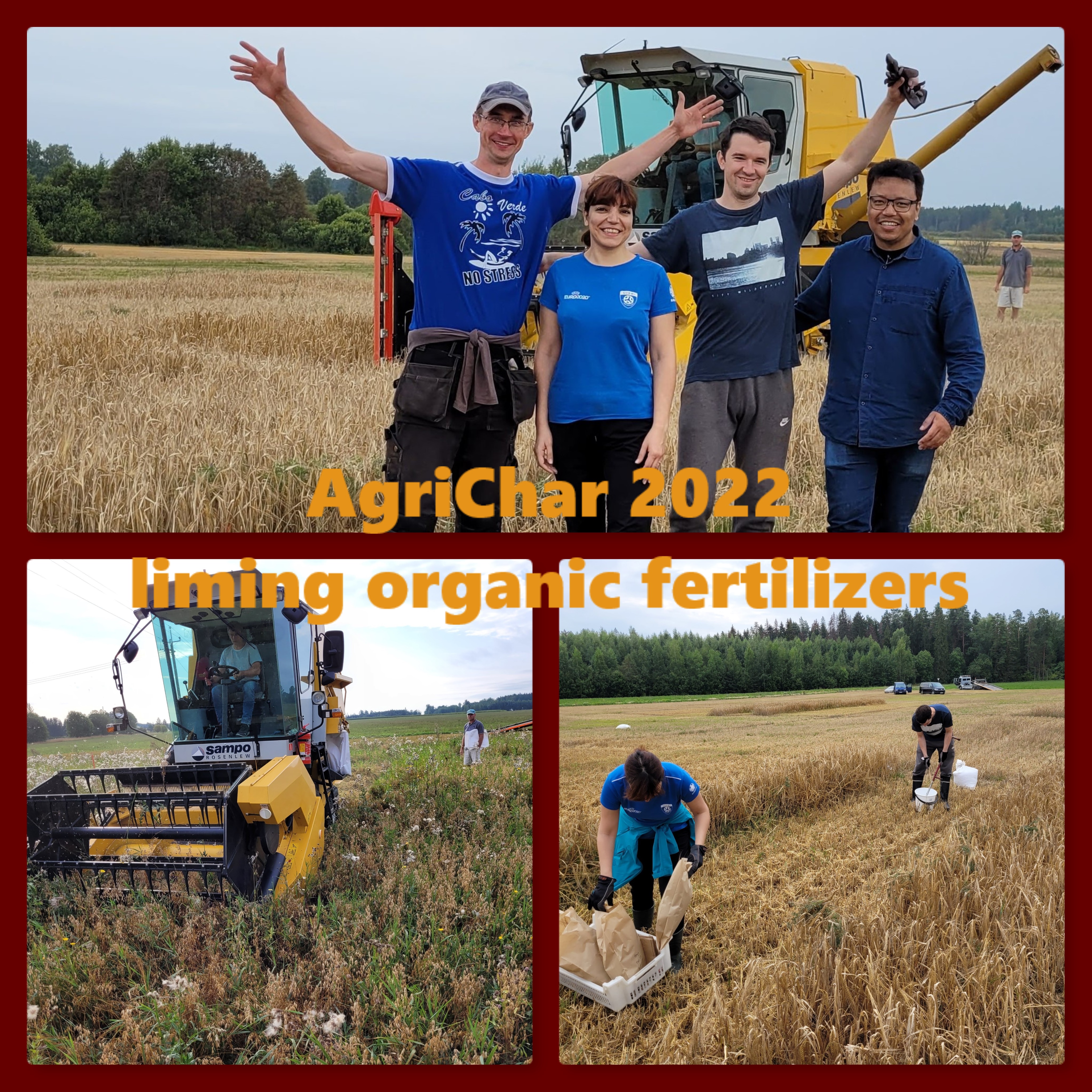
 Great success! Just before the rains we managed to sample and harvest our recycling fertilizer experiments focusing on granular fertilisers based on oil-shale ash and lime enriched with essential soil nutrients in Ahja and Aovere fields in Southern Estonia. The growing season was rather dry also in Estonia, but preliminary results are promising, both 2,5 t/ha and 5 t/ha application rates of fertilizer seemed to increase the yields. Next we will analyze the samples and finalize project reporting.

Dream Team of AgriChar group together with Estonian University of Life Sciences people managed well to sample and harvest the plots!

In this project we work in synergy with Estonian NGO Soil Innovation Cluster and Estonian University of Life Sciences, University of Tartu  and Ekosovellus and the aim of our work package is to test most suitable fertilizer recipes. Stay tuned for the results and check also other interesting results from the Cluster website https://soilprotection.earth!

Further, also our sediment recycling long-term field experiment and biochar drainage experiment were also sampled for plant and soil samples, as well as for leachate samples. And, of course, also the GHG emissions from the biochar and control treatments. This project is funded by Tiina and Antti Herlin Foundation, August Johannes and Aino Tiura Foundation as well as Emil Aaltonen Foundation. Thanks Mina, Subin and Jure for the excellent job!

Sunday, 15 May 2022

Field season 2022 started for AgriChar Estonian field experiments

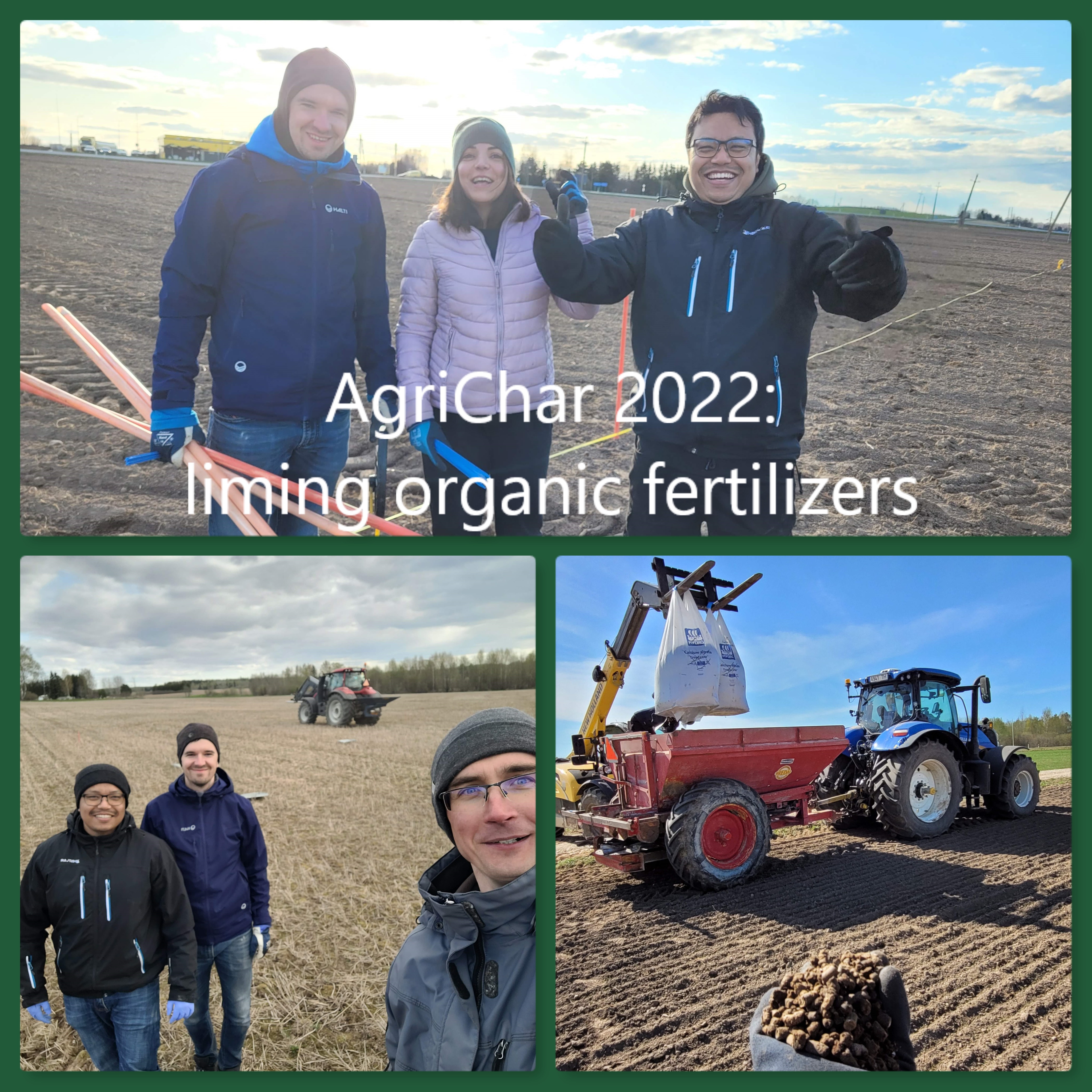
Past weeks we enjoyed the warm weather in Estonian fields, this growing season 2022 we have there four field experiments! 

First of all, our new recycling fertilizer experiments focusing on granular fertilisers based on oil-shale ash and lime enriched with essential soil nutrients is past the greenhouse experiment phase and with the most promising recipe we started now field experiments in Ahja and Aovere fields in Southern Estonia. By today, both fields have also been sown to cereals (oats and barley) and let's keep fingers crossed for some decent rain now!


In this project we work in synergy with Estonian NGO Soil Innovation Cluster and Estonian University of Life Sciences, University of Tartu  and Ekosovellus and the aim of our work package is to test most suitable fertilizer recipes. Stay tuned for the results and check also other interesting results from the Cluster website https://soilprotection.earth!

 We also fertilized our two field experiments in Viljandi and set them ready for new growing season. Our drainage experiment  where we added biochar as backfill filter material to see the effects on drainage water quality, has now functional, tailor-made measurement wells with V-notch that allow to record the flow rates (thanks to Pipelife Estonia). Further, with the funding from August Johannes and Aino Tiura Foundation as well as Emil Aaltonen Foundation we were able to purchase automated ultrasonic water level measurement devices produced by ELIS/sold by Konwell Estonia) that help us to record flow rates in drainage lines during the growing season. In early May 2022 we set these up while also measuring the GHG emissions from the treatments. 


Finally, we also started new field season for our lake sediment recycling field experiment (already sixth growing season!), collected there the leachate and sowed the plots to barley. Thanks for the great teamwork to all who participated, but especially Mina, Jure and Subin!

Our next plans are related with starting field season and measurements also here in Helsinki, with our two long-term biochar experiments. These start already 13th growing season!

Monday, 31 August 2020

Harvesting ongoing and drainage experiment started in August

 In these days our HYKERRYS team has been busy with harvesting rye and barley. The growing season has been more rainy here in Helsinki than in 2018 and 2019 and the bags seem heavier 😊 We also shot videos with key project partners to share the progress of the project, these will soon be uploaded to HYKERRYS website: https://blogs.helsinki.fi/hykerrys-hanke/


Harvesting HYKERRYS 2 barley yield, Aug 2020

HYKERRYS 2 coordinator Mari Unnbom at harvest 2020

 In the end of August 2020, AgriChar research group together with partners Carbofex Oy and Nivoo Oü started also our first biochar field experiment that focuses on long-term carbon sequestration via application of biochar to subsoil. The great majority of biochar field experiments worldwide study the effects when biochar is applied to topsoil (typically up to 20 cm depth), while technological challenges have hindered the application of it to deeper soil layers. In our fresh experiment in Estonia we study the effects of 5+ cm layer of EBC premium-grade spruce biochar on plant growth and nutrient leaching via drainage- as well as naturally the potential of sequestering C in this way. The experimental setup allows us to compare the effects of biochar to the control treatment with sand only. Looking forward for the results of this pioneering study funded by Tiina and Antti Herlin Foundation!

AgriChar 2020 drainage experiment started in August 2020


Thursday, 21 April 2016

The city of Stockholm pioneers in the biochar use and production


Last August I had chance to visit the city of Stockholm and hear about their biochar efforts. It is really impressive what they have succeeded within past five years or so, much thanks to the enthusiasm of Mr. Björn Embrén from City of Stockholm’s Landscaping Department.

It all started more than 15 years ago, when Björn noticed that trees perform poorly in compacted urban soils. It was costly to plant trees, fertilize and take care of them- and if they were not doing well, they had no landscaping value and they had to be replaced. On the other hand, there were trees growing on sides of rock walls or on top of old chimneys, where rarely any soil existed- so it was not soil that the roots needed but effective aeration (CO2 away and oxygen to the roots), moisture and nutrients.

They then started experimenting with structural soils, a planting holes with a layer of big, 3-7 cm diameter rocks in the bottom and soil washed between the rocks.

This was a success, and as the next step, in 2009, they switched to using biochar instead of soil for all of their urban tree planting projects. They have found that the main advantage of biochar for urban tree projects over other soil amendments is that it resists compression and compaction.  The crushed stones and biochar mix results in an improved porosity in the soil (roughly 40%).  Increased porosity facilitates better gas exchange, permeability leading to improved root penetration.

Schematics from Björn Embrén.


A further improvement on their methods has been to have the biochar and stones delivered pre-mixed.  They have found that this saves up to 25% in time and labour costs.  The preferred biochar particle size of the biochar is between 1 – 10 mm and currently they recommend approximately 2.25 cubic meters of biochar   for each urban tree (likely mixed with rocks already, but still quite a lot!).  This explains why loads of biochar from Europe have been shipped to Stockholm, mostly from Germany but also from  RPK Hiili OY (Mikkeli, Finland).

In order to be truly sustainable, however, a goal of using locally produced biochar from underutilized biomass was set. To attain this goal the City of Stockholm initiated the Stockholm Biochar Project with the objective of producing both biochar and renewable energy using urban green waste collected from municipal parks as well as city residents.  This particular biomass is often difficult to dispose of and very much underutilized.
The Stockholm Biochar Project team succeeded in winning one of the five coveted prizes of the 2014 Mayors Challenge funded by Bloomberg Philanthropies and the EUROCITIES organization which netted them 1 million euros to be used to set up their initial pilot plant.

We visited the plant last summer and according to latest news in the Biochar journal, it will produce its first tons of biochar within a few months from now, in summer 2016! The pilot plant will start from producing 300 tonnes of biochar per year and at full scale, will reach 1,500 tonnes per year. The heat generated during production will be added to a local or district heating network. Biochar will be used both by city residents and by city landscapers in public parks and urban tree beds. Probably we will soon see many other cities following the example and getting their green waste recycled, carbon fixed and trees happy!

Read more and see images at: https://www.biochar-journal.org/en/ct/77-Planting-Urban-Trees-with-Biochar