Monday, 27 April 2020

The research of Biar Deng on potential of biochar on Sub-Saharan Africa: from taking cover from mortars hitting the agroforestry field experiment in South Sudan to online PhD defense due to COVID19


Rainfed crop cultivation in drylands is a sort of adventure that no single farmer can predict its outcome. This is very true about crop production in the sub-Saharan Africa where scattered small holder farmers engage in rainfed crop cultivation. Despite its challenging environment, dryland’s rainfed agriculture is a key practice for food security in many countries including South Sudan.

The research of fresh PhD Biar Deng of AgriChar research group was inspired by this annual challenge of farmers for food production in rainfed areas in South Sudan, particularly in Renk County in northern part of the country. His first visit to the project site before conducting the field experiment shaped the study design and its layout. It was striking to notice how small farmers cultivate crops and manage their farms. The common prevailing understanding amongst the farmers was to pour less money to the soil (less investment), which may be attributed to uncertainty about the crop yields and feasibility of the crop production system. Also, the existence of trees on farm (old trees and annually regenerated tree seedlings) is negatively perceived by farmers (attract birds, compete with crops, and related tree tenure conflict with forest officials) despite their enormous benefits. Consequently, trees are continuously cleared from the farms and subjecting therefore, soil to erosion and degradation.

A long-term study was designed to be conducted in Renk, South Sudan to investigate soil fertility aspects and possibly increase in yield of sorghum crop; the main staple food in Renk and South Sudan. Therefore, testing of Acacia seyal agroforestry system and addition of biochar were viable options. The establishment of the field experiment went well as planned in 2011.

Land preparation at the study site

However, there was a mounting threat of sabotaging the study site by newly resettled South Sudanese (returnees) in Renk coming from Sudan after separation of South Sudan on July 9 2011. There was a high demand for poles and building materials and charcoal, and almost all big trees around the farm were cut. Also, roaming animal herds (i.e. cattle, goats, camels) in the area necessitated to hire a permanent guard. Despite this measure, children from Magara Village had managed to destroy many soil moisture tubes and filled other with soil. So, we were forced to drop the direct soil moisture measuring as component in the study.

The deterioration in security situation in the Renk County which is neighbouring Sudan due to border hostilities where gunfire and mortars were exchanged on many occasions was a big threat for continuing the field experiment. However, we had managed to carry out the field experiment for two seasons, (2011 and 212), but we were unable to return to the study site in 2013 due to increased insecurities in the country.


It was crucial to discuss possible alternative study plan with supervisors while Biar was in South Sudan in the light of developing events on the ground. Therefore, we had agreed to go on with the basic plan (field and greenhouse studies) with certain modifications. Results of the field experiment and greenhouse trial did not reflect the expected effects of biochar application on soil and sorghum yield, partly perhaps because the experimental years were quite rainy. Hence, we had opted to model the relationship using the AquaCrop model, which reflected possible benefits of using biochar in dry years.

Biar: “In summary, I think the study was a great opportunity for me and for the local farmers as well to experience different production approaches such as intercropping multipurpose trees (A. seyal) with cereal crop such as sorghum in presence of biochar. I believe, there is a room for further in-depth research on this topic in the future as many other hypotheses can be tested.”

Finally, the Corona virus (Covid-19) had its fingerprint on this work as an external factor that shifted the universal procedures of holding public examination of the doctoral dissertation to an online event (the opponent Prof. Erik Karltun was in Sweden).
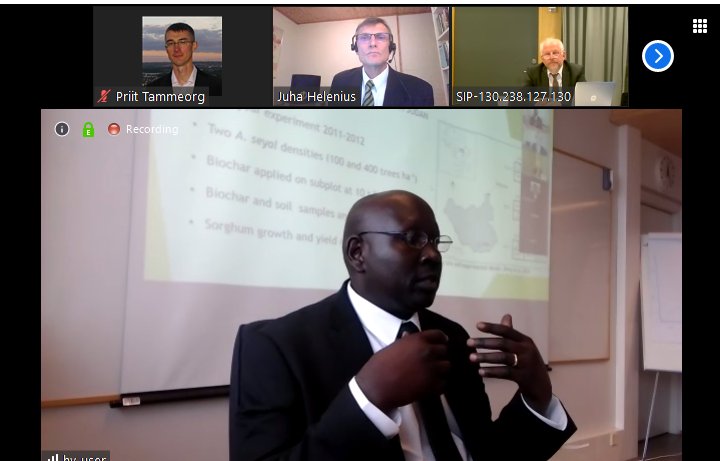
Public defense online
It was interesting but successful experience on 3rd of April 2020 where Biar became one of the first doctoral students ever who defended his PhD thesis online at the Faculty of Agriculture and Forestry, University of Helsinki. Congratulations Dr. Biar!

Biar's thesis can be found online here: https://helda.helsinki.fi/handle/10138/313359.


Tuesday, 31 December 2019

2019: another milestone year in biochar research and dissemination in Finland

The year 2019 is ending and it is really worth acknowledging the many important events our AgriChar research group was actively participating in. The most important event was the greatest ever biochar get-together in Finland. 4-6 September 2019 we had the pleasure to co-organize (together with International Biochar Initiative, Finnish Biochar Association, Fortum Puro and Carbofex Oy) the IBI Study Tour Finland. This event brought together 121 biochar experts and enthusiasts from 18 countries from all over the world, being a very nice next step from the last such world-scale event, the 2nd Nordic Biochar Seminar we organized six years ago in 2013. The presentations of the event can be seen online at the website of Finnish Biochar Association. We were honoured also by the presence of the Minister of the Environment and Climate Change of Finland, Ms. Krista Mikkonen!

Another important event we were part of was the final seminar of Carbon Lane project on 11 December 2019. This event was the final get together where our project team (consisting of people from University of Helsinki, Aalto University and also City of Helsinki) presented the fruits of our work. The Carbon Lane project focused on principles of urban demonstration areas for carbon sequestration  and was funded by EIT Climate-KIC. The presentations of that event will also soon be available on the project website, as well as the reports that are currently in the review phase. 

The year 2019 was extremely successful for biochar research and dissemination and we are happy to share many of our publications on this website with you soon. 

Happy New Biochar Year 2020 to all! 


Wednesday, 19 June 2019

Biochar breaking through in Finland during 2019!

The year 2019 seems really to be THE biochar year for Finland at least!

Many landmark issues have been launched recently, perhaps one of the most important globally is the launch of Puro Carbon removal marketplace in Finland. The platform has just held third auction for CO2 removal with great success and we're really glad that biochar is one of the pathways for C sequestration, alongside with carbonated and wooden building elements.


Biochar is getting attention also from national level policymakers in Finland. New Prime Minister of Finland, Mr. Antti Rinne's government agenda promises more funds and subsidies for research and practices that focus on carbon sequestration- on p 119 also #biochar as an example listed. .


Sequestering atmospheric carbon with the help of biochar will also be the main focus of the IBI Study Tour Finland during 4-6 September 2019. Everyone is welcome to join and hear the insights of the leading experts on carbon fixing (during 4th of Sept in Helsinki) and about use of biochar in urban contexts (5 and 6 Sept in Tampere). Registration is open already, so hurry up to get the early bird price (closes on 15 July!)

And last, before everyone sets out for the Midsummer holidays here in Finland, another great event coming in October: Nordic Biochar Conference in Stockholm on 16-17 October 2019Good chance to hear about ongoing biochar initiatives in the Nordics and discuss the path forward! The deadline for abstract submission is August 21st.


Thursday, 23 May 2019

Growing season 2019 started!

Last few weeks have been especially intensive for AgriChar research group, we have arranged fertilization and sowing for five field experiments and worked also with three other experiments. Our long-term field experiments with biochar added in 2010 and 2011 enter now already to tenth and ninth growing seasons, this week the sowing of barley and grass mixture was successfully completed! Next years we'll have different clover grasses and ryegrasses growing. Some rain would now be perfect!
Spring 2019, sowing biochar experiments


We have also conducted fertilization and sowing of our recycling fertilizers field experiments in HYKERRYS experiments in Haltiala, Vantaa and Knehtilä.
The first HYKERRYS project on recycling fertilizers is coming to end and starting from June 2019, we'll continue with HYKERRYS 2 with funding from the Ministry of Environment.

Last weeks have been intensive on the field with plot marking, fertilization and sowing and installation of equipment for greenhousegas measurements. Good job for all the HYKERRYS team, particularly coordinator Mari Unnbom and Jure Zrim! See more: https://www.researchgate.net/project/Good-Yield-Recycling-Fertilizer-HYKERRYS-Tila-HYKERRYS-and-HYKERRYS-2.


Furthermore, our results have been on show in different international conferences recently,

Subin Kalu was presenting in April at EGU2019 conference the highlights of our mechanistic study on how regular and Kon-Tiki nutrient loaded biochar affect nitrogen cycling.
And yesterday on 22 May, Mina Kiani presented the preliminary results from lysimeter and field experiments in AquaConSoil 2019 in Antwerp, Belgium. She explored the environmental impacts of lake sediment recycling as phosphorus-rich soil amendment. The method is promising but many new questions raised!
 

Tuesday, 18 December 2018

4th Finnish Biochar Seminar: Proceedings uploaded

On 11th December 2018, already fourth Finnish Biochar Seminar was held in Viikki, Helsinki. We at AgriChar research group & Finnish Biochar Association were happy to host this, already traditional, event! As usual, the event was a meeting point for networking and hearing the latest research and pilot case highlights from Finnish and Nordic research groups. Historically, we had participants from five countries: all over Finland, but also from Estonia, Sweden, Norway and even from Egypt!


In addition to poster session and demonstration of pyrolysis equipment, we had two sessions of interesting presentations covering pretty well all the biochar research being done in Finland and in the Nordics, from forestry and agriculture to urban ecosystems and market studies.


We are grateful to all the presenters for high-quality presentations!

You are welcome to check the presentations from http://biochar-hy.blogspot.com/p/4th-finnish-biochar-seminar.html!

Friday, 16 November 2018

As the first country in the world, Finland has free map covering all its biochar activities!

The Finnish Biochar Association is pleased to announce that the map of biochar activities in Finland is now published. The map is continuously updated and will include more details in the future (e.g., scale of each project).
See: https://www.suomenbiohiili.info/biochar-map.html


The map includes five different categories:
  1. Research organizations involved with biochar research
  2. Biochar companies who have their own biochar production or use contract manufacturers
  3. Finished projects, including practical biochar projects
  4. Ongoing projects, including planned or currently ongoing practical biochar projects
  5. Scientific research projects, conducted through applying scientific method and using controls, and which results are or will be made public (preferably in the form of peer-reviewed scientific articles).

There are projects about biochar located in around 30 different 
Finnish municipalities and cities. All of the top ten largest Finnish 
cities are involved (Helsinki, Espoo, Tampere, Vantaa, Oulu, Turku, 
Jyväskylä, Lahti, Kuopio, and Pori). Despite the high number of 
different finished and ongoing biochar projects across Finland, the 
scale of these projects has generally been small. Majority of the 
projects were completed during the last two years and many of them have 
been inspired by the example of the city of Stockholm, which has been 
using biochar as a standard material in the structural soil since 2009.
Image from City of Stockholm biochar project.

The key focus areas around the biochar projects in Finland are effects on crop and tree growth and stormwater management. The scale and number of projects are expected to increase in the upcoming years significantly. And yes, naturally also the AgriChar research group experiments are listed on the map!

Please cite the map as:
“Salo, E., Riikonen, A., Tammeorg, P., Elo, A. 2018. Map of biochar activities in Finland. Finnish Biochar Association (FBA). www.suomenbiohiili.info”

Wednesday, 19 September 2018

4th Finnish Biochar Seminar: 11 December 2018 in Viikki, Helsinki


AgriChar research group and Finnish Biochar Association are proud to welcome you to the 4th Finnish Biochar Seminar to share and hear the latest biochar research and pilots in Finland and in neighboring countries! 

 
During the meeting, we will also discuss the new Nordic Biochar Network, see: http://nordicbiochar.org!

 
Please fill in the form for registration at https://goo.gl/forms/p0YAao1mRZDFUsVC2

 
The registration ends on 26 November, after which the full details on practicalities will be sent to the registered participants to the e-mail address provided.

 
For the FBA members with paid membership fee, the access is free. To join the Finnish Biochar Association, please go to http://www.suomenbiohiili.info/join-us.html.

 Warm welcome! 


Monday, 13 August 2018

Harvest 2018 and our presentations at the 21st World Congress of Soil Science in Rio de Janeiro

We at AgriChar research group have successfully started the harvest season of 2018 from our long-term field experiments. The weather today was nice and sunny and yield of oats and barley were quite fine irrespective of the ‘Drought of a Decade’. 

The peas were not doing so good, after being attacked by geese during the Midsummer weekend, they were, much to our surprise, able to regrow all the leaves eaten and form pods, but then the pigeons finished off what was left from the geese.

When some of our group members are working on the fields in Finland, others are networking and reporting their latest results on the other side of the globe. Namely, three of our doctoral students, Mina, Jure and Subin are presenting at the 21st World Congress of Soil Science in Rio de Janeiro, Brazil

This event brings together around 7000 soil enthusiasts from around the world, among them also hundreds of biochar experts. 

If you are in Brazil, make sure not to miss AgriChar presentations:

Tomorrow, on August 14 at 1:50 PM, Mina Kiani will present her poster on impacts of lake sediment reuse on plant growth and soil properties in the field. Toten 42.

Next, on August 16 at 1:30 PM, Subin Kalu answers the question, to what extent spruce biochar acts as slow-release long-term fertilizer if applied to nutrient poor sandy soil. Toten 38

Those who are interested about effects of softwood biochars on soil biota in boreal soils, would not want to miss Jure Zrim’s presentation on August 16, at 2:20 PM. Toten 37.