Rainfed crop cultivation in drylands is a sort of adventure that no single farmer can predict its outcome. This is very true about crop production in the sub-Saharan Africa where scattered small holder farmers engage in rainfed crop cultivation. Despite its challenging environment, dryland’s rainfed agriculture is a key practice for food security in many countries including South Sudan.
The research of fresh PhD Biar Deng of AgriChar research group was inspired by this annual challenge of farmers for food production in rainfed areas in South Sudan, particularly in Renk County in northern part of the country. His first visit to the project site before conducting the field experiment shaped the study design and its layout. It was striking to notice how small farmers cultivate crops and manage their farms. The common prevailing understanding amongst the farmers was to pour less money to the soil (less investment), which may be attributed to uncertainty about the crop yields and feasibility of the crop production system. Also, the existence of trees on farm (old trees and annually regenerated tree seedlings) is negatively perceived by farmers (attract birds, compete with crops, and related tree tenure conflict with forest officials) despite their enormous benefits. Consequently, trees are continuously cleared from the farms and subjecting therefore, soil to erosion and degradation.
A long-term study was designed to be conducted in Renk, South Sudan to investigate soil fertility aspects and possibly increase in yield of sorghum crop; the main staple food in Renk and South Sudan. Therefore, testing of Acacia seyal agroforestry system and addition of biochar were viable options. The establishment of the field experiment went well as planned in 2011.
 |
| Land preparation at the study site |
However, there was a mounting threat of sabotaging the study site by newly resettled South Sudanese (returnees) in Renk coming from Sudan after separation of South Sudan on July 9 2011. There was a high demand for poles and building materials and charcoal, and almost all big trees around the farm were cut. Also, roaming animal herds (i.e. cattle, goats, camels) in the area necessitated to hire a permanent guard. Despite this measure, children from Magara Village had managed to destroy many soil moisture tubes and filled other with soil. So, we were forced to drop the direct soil moisture measuring as component in the study.
The deterioration in security situation in the Renk County which is neighbouring Sudan due to border hostilities where gunfire and mortars were exchanged on many occasions was a big threat for continuing the field experiment. However, we had managed to carry out the field experiment for two seasons, (2011 and 212), but we were unable to return to the study site in 2013 due to increased insecurities in the country.
It was crucial to discuss possible alternative study plan with supervisors while Biar was in South Sudan in the light of developing events on the ground. Therefore, we had agreed to go on with the basic plan (field and greenhouse studies) with certain modifications. Results of the field experiment and greenhouse trial did not reflect the expected effects of biochar application on soil and sorghum yield, partly perhaps because the experimental years were quite rainy. Hence, we had opted to model the relationship using the AquaCrop model, which reflected possible benefits of using biochar in dry years.
Biar: “In summary, I think the study was a great opportunity for me and for the local farmers as well to experience different production approaches such as intercropping multipurpose trees (A. seyal) with cereal crop such as sorghum in presence of biochar. I believe, there is a room for further in-depth research on this topic in the future as many other hypotheses can be tested.”
Finally, the Corona virus (Covid-19) had its fingerprint on this work as an external factor that shifted the universal procedures of holding public examination of the doctoral dissertation to an online event (the opponent Prof. Erik Karltun was in Sweden).
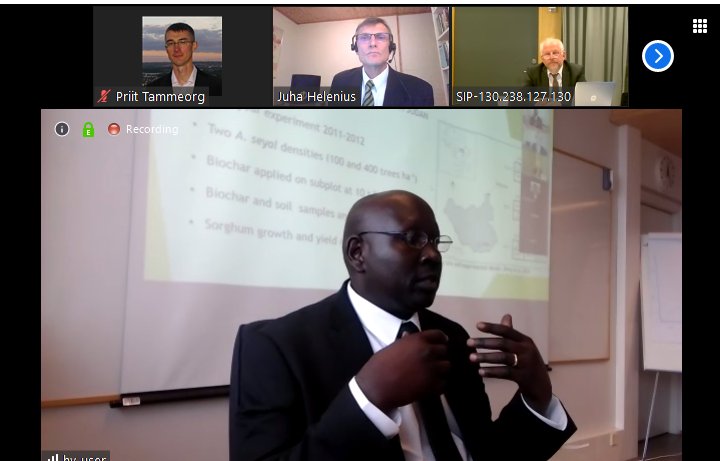 | |
| Public defense online |
Biar's thesis can be found online here: https://helda.helsinki.fi/handle/10138/313359.


