Thursday, 19 May 2022

Can the agricultural and environmental benefits of biochars be expected after several years of field application?


Application of biochars to soils is gaining popularity because of their ability for sequestering atmospheric carbon as well as bringing beneficial agricultural and environmental effects. Biochars have potential to improve soil fertility and enhance crop productivity as well as reduce greenhouse gas (GHG) emissions and nutrient leaching. However, one of the important knowledge gaps in biochar research is whether these beneficial effects exist after several years of field application. 

To know this, we measured properties of plant and soil, fluxes of greenhouse gases, and leaching of nitrogen from four already established field experiments on various types of Finnish soils where biochars were applied 2-8 years prior to this study. This includes two of AgriChar long-term biochar experiments from Viikki, sampling was done in 2018.

The major effects observed were:

1)      No effects of biochar on crop yield were observed on two field experiments but the spruce biochar increased barley grain yield by 65% after 7 years of field application in a coarse-textured Umbrisol in Viikki. As a result, CH4 + N2O emitted per ton of grain yield is reduced by 43%. Similarly, in a clayey Cambisol, where spruce and willow biochars were applied 2 years ago, only the spruce biochar significantly increased oat grain yield by 75%.

2)      In the clayey Cambisol, the increased crop yield by the spruce biochar was related to its ability to hold nitrate ions, which was available for plant uptake. However, such effect was not observed for the willow biochar. We hypothesize that the ability of retaining soil nitrate is related to the surface area of biochar since the surface area of the spruce biochar (328 m2 g-1) was much higher than the willow biochar (1.3 m2 g-1).

3)      In the same clayey Cambisol field, where mineral nitrogen leaching test was also measured, we found that biochar has potential to reduce N2O flux and nitrate leaching especially during the peak emission or leaching period. However, no clear effects on fluxes of N2O or CH4 were observed on other field experiments.

Based on this, it can be concluded that the positive effects of biochars such as increase in crop yield and plant N availability, decrease N2O emissions and N leaching could be observed even after several years of biochar application, however, it depends on soil and biochar types as well as the environmental conditions.

Please read the full study here: Subin Kalu et al. 2022. Potential of Biochar to Reduce Greenhouse Gas Emissions and Increase Nitrogen Use Efficiency in Boreal Arable Soils in the Long-Term

https://doi.org/10.3389/fenvs.2022.914766.

Sunday, 15 May 2022

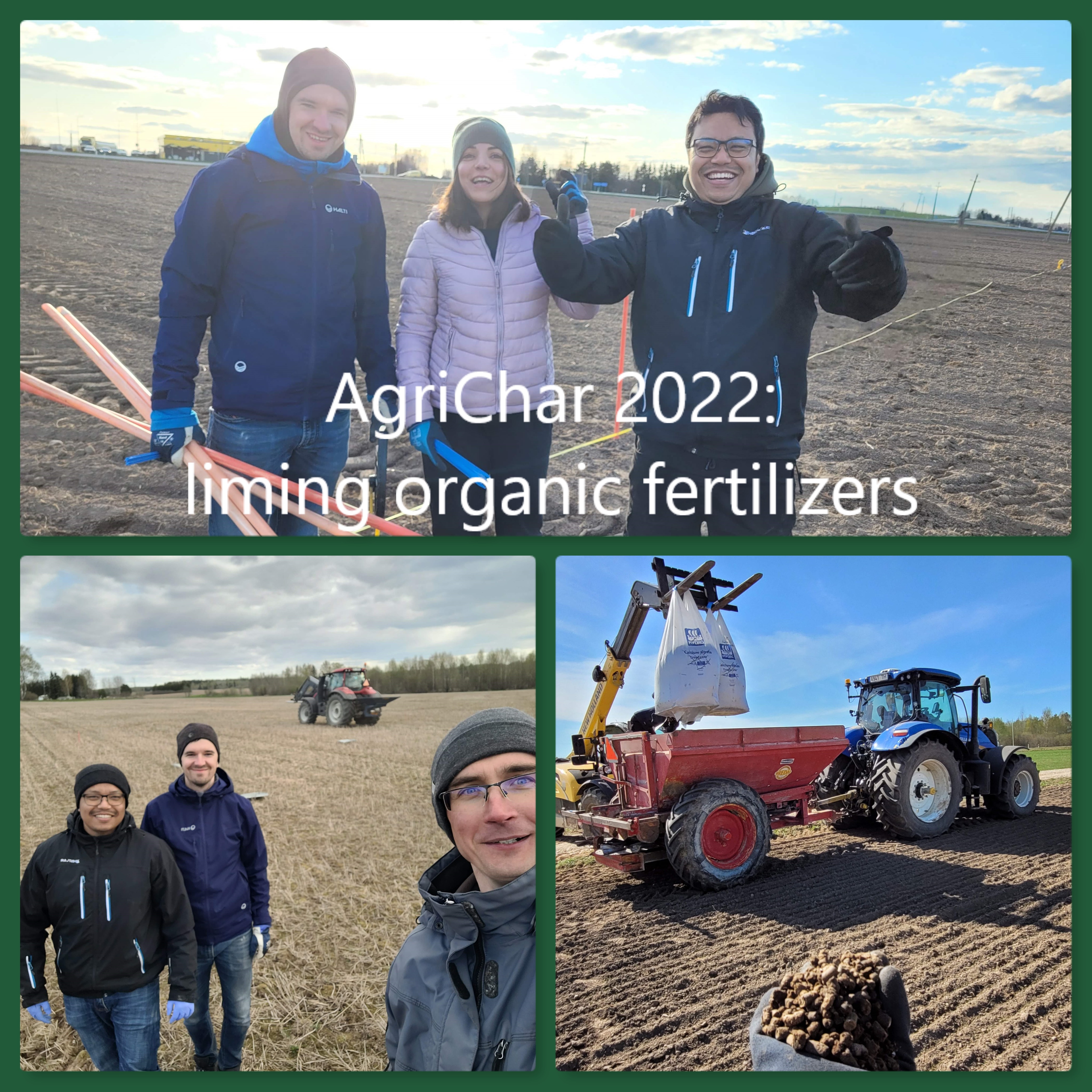
Field season 2022 started for AgriChar Estonian field experiments

Past weeks we enjoyed the warm weather in Estonian fields, this growing season 2022 we have there four field experiments! 

First of all, our new recycling fertilizer experiments focusing on granular fertilisers based on oil-shale ash and lime enriched with essential soil nutrients is past the greenhouse experiment phase and with the most promising recipe we started now field experiments in Ahja and Aovere fields in Southern Estonia. By today, both fields have also been sown to cereals (oats and barley) and let's keep fingers crossed for some decent rain now!


In this project we work in synergy with Estonian NGO Soil Innovation Cluster and Estonian University of Life Sciences, University of Tartu  and Ekosovellus and the aim of our work package is to test most suitable fertilizer recipes. Stay tuned for the results and check also other interesting results from the Cluster website https://soilprotection.earth!

 We also fertilized our two field experiments in Viljandi and set them ready for new growing season. Our drainage experiment  where we added biochar as backfill filter material to see the effects on drainage water quality, has now functional, tailor-made measurement wells with V-notch that allow to record the flow rates (thanks to Pipelife Estonia). Further, with the funding from August Johannes and Aino Tiura Foundation as well as Emil Aaltonen Foundation we were able to purchase automated ultrasonic water level measurement devices produced by ELIS/sold by Konwell Estonia) that help us to record flow rates in drainage lines during the growing season. In early May 2022 we set these up while also measuring the GHG emissions from the treatments. 


Finally, we also started new field season for our lake sediment recycling field experiment (already sixth growing season!), collected there the leachate and sowed the plots to barley. Thanks for the great teamwork to all who participated, but especially Mina, Jure and Subin!

Our next plans are related with starting field season and measurements also here in Helsinki, with our two long-term biochar experiments. These start already 13th growing season!

Wednesday, 26 January 2022

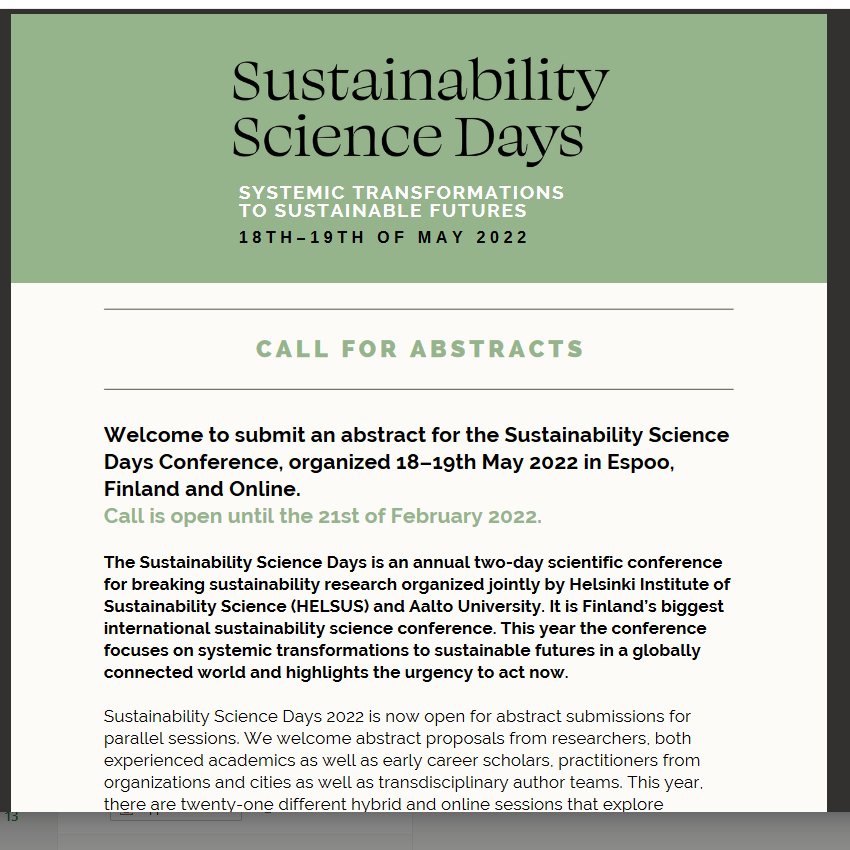
Welcome to Sustainability Science Days 2022 on 18-19 May

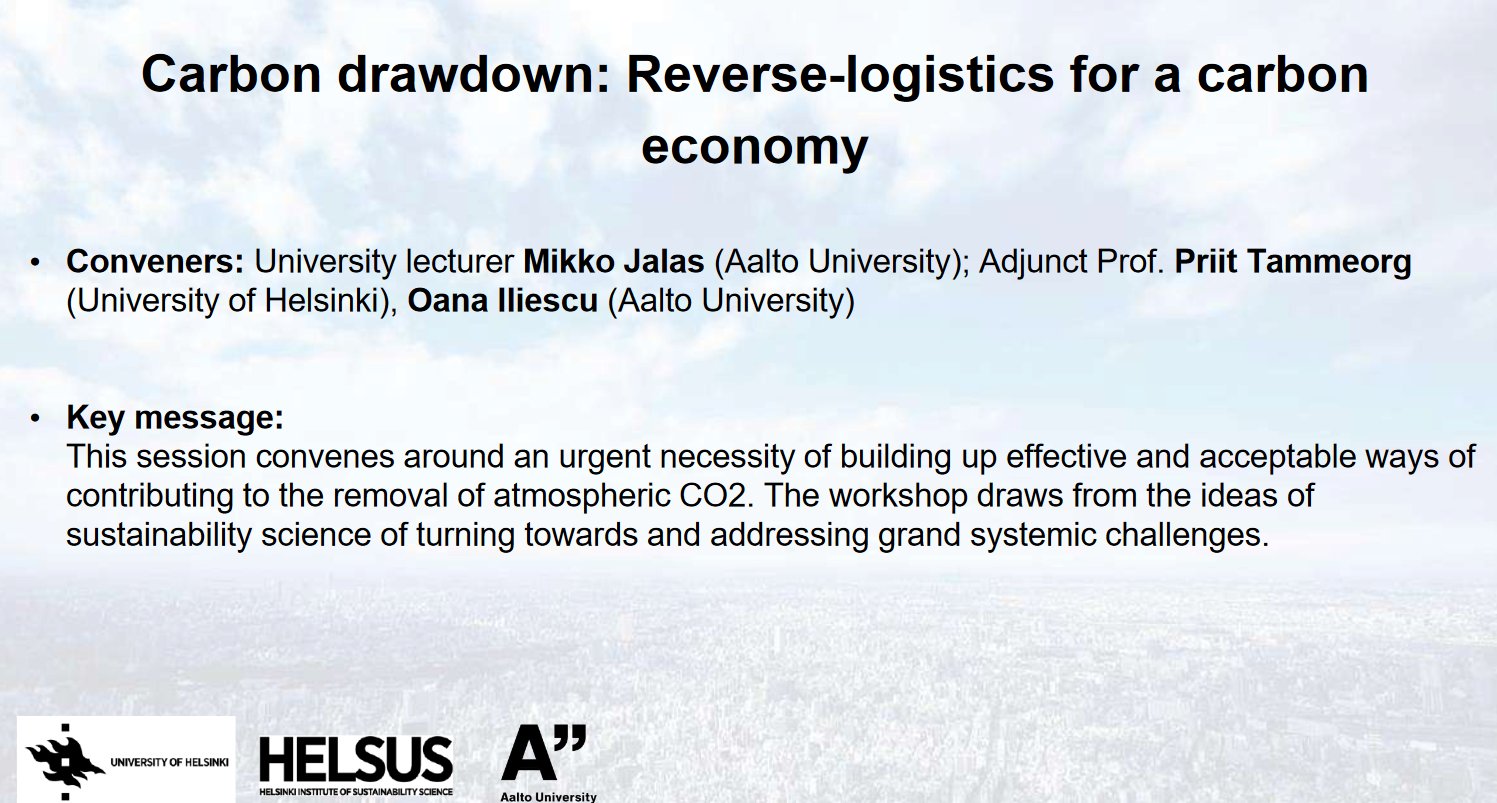
 Warm welcome to Sustainability Science Days 2022 on 18-19 May! We especially welcome to submit abstracts to Session 13. #Carbon drawdown: Reverse-logistics for a carbon economy! Please submit your abstract by 21 Feb!

Image

This session convenes around an urgent necessity of building up effective and acceptable ways of contributing to the removal of atmospheric CO2. The workshop draws from the ideas of sustainability science of turning towards and addressing grand systemic challenges. 

Description:

For several centuries, humans have excelled in mobilising fossil fuel reserves and converting them to atmospheric CO2. The current state of climate emergency and the need for deep-reaching societal and metabolic transformations calls for a reversal of this logic: large-scale, effective and even profitable ways of drawing carbon down from the atmosphere. This track invites papers that address all processes, mechanisms, designs and economic models in which carbon in captured through plant biomass and sequestered. 

Relevant questions and topic include but are not limited to 

  • the cycles of carbon in forests, agricultural land and urban green areas 

  • processes of treating streams of organic material to produce biochar and other stable carbon products and compounds 

  • transformations of the forest industry to propel carbon drawdown 

  • qualities and the use of biochar in different applications 

  • economics, business models and regulation of carbon drawdown 

  • systemic mapping of potential of and conditions for large-scale carbon drawdown in different geographical context and sectors of human activity

    Image

Conveners: Mikko Jalas (Aalto University) & Priit Tammeorg (University of Helsinki)

Submit via https://www.helsinki.fi/en/conferences/sustainability-science-days-conference-2022/call-abstracts

Thursday, 23 December 2021

Our greenhouse experiment on lake sediment phosphorus recycling up and running!

Past months we have been busy with collecting, drying and recycling muddy sediments from lakes in Estonia and Finland- and now the sediments are applied to pots in greenhouse and ryegrass thriving in them.

 
The experiment is a part of the project searching ways of sustainable lake restoration by sediment removal and subsequent sediment phosphorus (P) reuse in agriculture. As we know, large amounts of P are concentrated in lake sediments, and water quality problems (eutrophication) are often related to the release of this P. At the same, the scarcity of mineral P resources is challenging future society. Hence we focus holistically on both lake ecosystem functioning and agroecological sustainability.

Such a practice appeared to be successful in our pilot study area Lake Mustijärv (in central Estonia). In the lake, changes in P release from sediments were related to the variations in iron-bound P (Kiani et al., 2020). At the same time, this fraction was the major source of P for the grass uptake in the experimental study on the sediment P reuse (Kiani et al., 2021). Our recent studies of the four eutrophic lakes in southern Finland (Päijät-Häme region) revealed similarity of the mechanisms behind sediment P release, indicating a high potential for the sustainable model of lake restoration by sediment removal and reuse in agriculture in these lakes. However, the bioavailability of the sediment P is likely low, as soils (and sediments) in Finland are saturated with iron.

In our latest experiment, we explore whether biochar, lime and arbuscular mycorriza can improve the availability of sediment P for crops (ryegrass). We test the fertilizing ability of sediments from the four lakes of the Päijät-Häme region (Enonselkä basin of Lake Vesijärvi, Matjärvi, Kutajärvi, Kymijärvi), but also from two Estonian lakes having different geology. The results will be extrapolated for larger areas, based on the sediment properties from a variety of lakes in southern Finland analysed within the project.

The project is led by Dr Olga Tammeorg (Ecosystems and Environment Research Programme, University of Helsinki) in synergy with our AgriChar Research group. We acknowledge particularly Päijät-Häme Regional Fund of Finnish Cultural Foundation and Niemi Foundation for providing funding and our Dream Team of hard-working assistants from France: Lena, Jeanne, Diane, Kevin for all their help. Finally, we highly appreciate the support of Vesijärvi Foundation and City of Lahti and University of Tartu, especially Dr Tanel Vahter for collaboration.


We wish everyone Merry Christmas and a Happy New Year 2022!

Saturday, 4 December 2021

New recycling fertilizer experiments & growing season 2021 sample analyses ongoing

 We are happy to announce that our new recycling fertilizer experiments focusing on granular fertilisers based on oil-shale ash and lime enriched with essential soil nutrients is past the laboratory testing phase. In this project we work in synergy with Estonian NGO Soil Innovation Cluster and Estonian University of Life Sciences, University of Tartu  and Ekosovellus and the aim of our work package is to test most suitable fertilizer recipes for their liming and fertilisation efficiency first in lab tests and then in lab incubation. 

Lab and greenhouse tests of new granular organic fertilisers in Helsinki.
 

The recipes include mainly oil shale ash, dolomite, limestone, meat bone meal and vinasses in different proportions and currently we are finalizing report on the lab tests. Some of the fertilisers were comparable to limestone in regards of liming efficacy and also were quite promising with their fertilising properties. Now in winter we are continuing with the next step, greenhouse experiment with most promising fertilisers with barley as the crop. Next summer 2022 we will continue to field experiments, stay tuned for the results and check also other interesting results from the Cluster website https://soilprotection.earth!

Naturally, our field experiments have all been also harvested by now and plant and soil samples being currently analysed in labs. The grass yield of long-term biochar experiments was harvested in September, and under the professional coordination of Mari Unnbom, also the yields of HYKERRYS recycling fertiliser experiment were harvested, even the faba beans where we had most challenges this year. The active experimentation and monitoring in HYKERRYS experiments ends this autumn, closing five-year crop rotation 2016-2021 and thus MSc students Heikki Sikanen and Nea Similä study carefully also the longer-term effects on soil aggregate stability and water retention capacity composts and other fertilisers had. 

Harvesting, sampling and analyses of nutrient uptake and soil aggregate stability from our field experiments 2021.

Further, this autumn our research group is strengthened with four amazing trainees from UniLaSalle, France: Kevin Van Assche, Diane Maujoin,  Jeanne Bideault and Lena Jacquot. They have been busy with field sampling, yield analyses as well as what you see in the photo, analyses of nutrient uptake of plants from different fertilisers. A dream team indeed!


Tuesday, 5 October 2021

CarbonPark #HiiliPuisto measurements 2021 complete, news story in national media YLE news

 We visited the #HiiliPuisto #carbon sequestration park in Jätkäsaari Helsinki for the autumn 2021 measurements of trees and they were doing great! We took also some additional soil samples to find out more. As recently our policy brief on general principles of such C parks was published (https://www.frontiersin.org/articles/10.3389/fenvs.2021.672468/full), the flagship national news program of YLE news made a story on the research, too.


 Check out https://areena.yle.fi/1-50621874?seek=849 and read a more thorough story here https://yle.fi/uutiset/3-12116000!


Thanks to all the team of CarbonLane project and #HiiliPuisto projects for fruitful collaboration! The work was done in collaboration with Aalto University and University of Helsinki and City of Helsinki. The growing media was provided by all major Finnish growing media companies BiHii, Biolan, Carbofex and Kiteen Mato ja Multa, HSY, Kekkilä and Tieluiska. The Carbon Lane project was funded by EIT Climate-KIC and the first follow-up project of the park, #Hiilipuisto, by Maiju ja Yrjö Rikalan Puutarhasäätiö. Thank you all, let's keep up the good work! 


Soon we will report the findings of 2020-2021, the first years after the park was established. But we'll continue the follow up in coming decades!


Thursday, 19 August 2021

Co-Designing Urban Carbon Sink Parks: Case Carbon Lane in Helsinki

 In order to achieve the goals of carbon (C) neutrality within next 20 year, municipalities worldwide need to increasingly apply negative emission technologies. In our latest Policy Brief published in Frontiers in Environmental Science we focus on the main principles of urban demonstration areas using biochars for C sequestration and explore the lessons learned from a co-creation process of one such park, Hyväntoivonpuisto in Helsinki, Finland. 


We found that the demonstration sites of urban C sinks in public parks must be safe, visible and scientifically sound for reliable and cost-effective verification of carbon sequestration. We find that different interests can be arbitrated and that synergy that emerges from co-creation of urban C sink parks between stakeholders (scientists, city officials, companies, and citizens) can result in demo areas with maximized potential for impact, dissemination and consideration of principles of scientific experimentation.

We acknowledge the funding for the Carbon Lane project by EIT Climate KIC Early innovation project # 190365, the full report the policy brief is based on is available at https://www.aalto.fi/fi/Carla. We also acknowledge the funding from Maiju ja Yrjö Rikalan Puutarhasäätiö for funding the first follow-up project of the Carbon Lane park, #Hiilipuisto. We are very grateful also for all the stakeholders and scientists who participated the workshops providing input for both the principles and design for the urban C sink parks.

See more:


Tuesday, 6 July 2021

Growing season 2021 updates and challenges

 The growing season 2021 has once again proved to be special, also for our research group. Our long-term biochar field experiments in Helsinki were fertilised quite late this year as the sowing equipment was busy in HYKERRYS recycling fertiliser fields (wheat, barley and faba bean) and also other field experiments due to heavy rains in May. For instance, in the Helsinki-Vantaa airfield meteorological station, the May 2021 had the all-time highest precipitation, 92 mm, more than double that of long-term average! Many fields in Finland were too wet for sowing until only mid-June, so record late sowing of spring cereals was not only our case :)

 In Viikki experiments we thus had to use the narrow time window sowing equipment was available, that meant also working in the moonshine at midnight. Few weeks later we already harvested first yield of grasses.

In June we also visited our urban carbon fixing biochar park #HiiliPuisto in Jätkäsaari Helsinki, measured all the trees growing in different compost-biochar mixtures (also the ones that were replaced this spring) and also took the samples for water retention characteristics of different growing media from topsoil and also subsoil. The trees are thriving nicely and so do the flower meadows! Currently we're measuring in the laboratory, how much plant-available water can these growing medias hold.