Tuesday, 14 February 2023

What are the agronomic and environmental impacts of recycling lake sediments to crop production? Our 4-y field study published, Mina's PhD defense soon!

 We are trying to find a sustainable solution for closing the leaking agricultural #phosphorus (P) cycle by #recycling P-rich lake #sediments back to the agriculture. It is globally the first study that covers environmental aspects of recycling lake sediments to agriculture over several years:


Excavating all the 7500 m3 of sediment from a 1-ha shallow eutrophic Lake Mustijärv (Viljandi, Estonia) was the starting point of this work. During the lake restoration, 6.4 Mg of P was removed, including at least 2.4 Mg of P that was potentially bioavailable.

During a four-year field experiment on the shore of the restored lake, various application methods were examined to use large quantities of lake sediments for grass production with the following treatments: the agricultural control soil (Soil) surrounding the lake, pure sediment (Sed), #biochar treated sediment (SB), and biochar and soil mixed with sediment (SSB). In addition to the plant growth investigation, we estimated the environmental impacts of different sediment application methods by analyzing greenhouse gas emissions, N and P leaching, aggregate stability, and soil biota.

From this study we learned that the sediment-based growing media sustained grass biomass yield in the field condition, even though yield enhancement was less obvious compared with our previous lysimeter experiment. Sediment from Lake Mustijärv was rich in organic matter and was a good source of several essential nutrients, including P, in plant-available form. In addition to P, the sediment had high solubility of essential plant nutrients including sulfur (S), calcium (Ca), magnesium (Mg), boron (B), zinc (Zn), and a fair supply of copper (Cu). Also, the sediment continuously provided a moderate supply of N to the plants over the four-year field experiment, which was likely due to mineralization of the organic reserves of the sediment.

Considering the environmental impacts, the sediment-based growing media had higher carbon dioxide (CO2) emissions yet broadly similar nitrous oxide (N2O) emissions compared with the soil surrounding the lake. Also, applying a thick layer of excavated sediment (~2000 t ha−1) increased the risk of P and mineral N leaching. The application of biochar increased the amount of N taken up by the plants but did not significantly reduce emissions or leaching.

In addition, sediment-based growing media had different bacterial and fungal community compositions compared with soil. This could result in different mineralization pathways in soil and sediment-based treatments. The bacterial phyla associated with solubilizing P, including Proteobacteria and Chloroflexi, were more abundant in the sediment material than in Soil. This is while the relative abundances of Actinobacteria and Planctomycetes, with the potential to accumulate bioavailable P fractions, were higher in Soil.

Further study is required to determine if the GHG emissions and nutrient leaching from recycled lake sediment can be reduced by using it in lower quantities, similar to organic fertilizers and soil amendment materials. Also, the life-cycle assessment of environmental impacts of sediment recycling of eutrophic lakes for agricultural purposes is suggested for the future research.

This novel study was third chapter of the doctoral thesis of Mina Kiani. Her thesis “Closing the Phosphorus Cycle by Recycling Lake Sediments in Agriculture” is currently being prepared for printing. 

 Those interested on latest research and developments in the field of recycling phosphorus from lake sediments are most welcome to join the public defense of her doctoral thesis this spring. The details are published soon in the website of AgriChar research group (http://biochar-hy.blogspot.com/) but tentatively, the public examination is planned for 21 April 2023. Save the date!


Please check the following recently published articles for more:

 Kiani, M., Zrim, J., Simojoki, A., Tammeorg, O., Penttinen, P., Markkanen, T., & Tammeorg, P. (2023). Recycling eutrophic lake sediments into grass production: A four-year field experiment on agronomical and environmental implications. Science of The Total Environment, 161881.

Kiani, M., Tammeorg, P., Niemistö, J., Simojoki, A. and Tammeorg, O., 2020. Internal phosphorus loading in a small shallow Lake: Response after sediment removal. Science of The Total Environment, p.138279.

Kiani, M., Raave, H., Simojoki, A., Tammeorg, O. and Tammeorg, P., 2021. Recycling lake sediment to agriculture: Effects on plant growth, nutrient availability, and leaching. Science of The Total Environment, p.141984.

This project was supported by AGROREE doctoral school, Maa- ja vesitekniikan tuki ry, Suomen luonnonsuojelunsäätiö Itämerirahasto, Ella ja Georg Ehrnrooth Foundation, Finnish Cultural Foundation, Niemi Foundation, Tiina and Antti Herlin Foundation& great help of colleagues & friends including Martin Voll, Kalle Köömnemägi, Heli Ahola, Merve Kujala,Helena Soinne, Ave Truhanov, Miia Collander, Markku Tykkyläinen, Marjo Kilpinen, Kaj-Roger Hurme, Sanna Peltola, and Subin Kalu.

Friday, 14 October 2022

Lake sediments as fertilisers: plant nutrient uptake analysed with brand-new ICP device

 This week we finished data collection phase to our sediment recycling experiment. The greenhouse experiment was harvested in spring 2022 (see more of the background here: http://biochar-hy.blogspot.com/2021/12/our-greenhouse-experiment-on-lake.html), then the plant samples were ground and nutrients extracted from them. In September-October we developed analysis methods for multi-element analysis for our brand new ICP-OES device Thermo Scientific iCAP PRO XP Duo, likely one of the newest such devices in Northern Europe! The device and its user interface impressed us with its flexibility, but, admittedly, there were quite some things for us to learn and try too. Thanks to our lab technician Kati Hakala for being always there for us!


The experiment was a part of the project searching ways to improve the availability of recycled lake sediment phosphorus and other nutrients for crops (ryegrass). We test the fertilizing ability of sediments from the four lakes of the Päijät-Häme region (Enonselkä basin of Lake Vesijärvi, Matjärvi, Kutajärvi, Kymijärvi), but also from two Estonian lakes having different geology. The results will be extrapolated for larger areas, based on the sediment properties from a variety of lakes in southern Finland analysed within the project.

The project is led by Dr Olga Tammeorg (Ecosystems and Environment Research Programme, University of Helsinki) in synergy with our AgriChar Research group. We acknowledge particularly Päijät-Häme Regional Fund of Finnish Cultural Foundation, Maa- ja vesitekniikan tuki ry and Niemi Foundation for providing funding and our Dream Team of hard-working young scientists, Anu Suwal, Nikolai Baranov, Joni Vihavainen, Mina Kiani and Subin Kalu for sample preparation and analysis. Well done!!!

Next step is to analyse the data and wrap up reports, stay tuned!


Sunday, 9 October 2022

CarbonPark #Hiilipuisto tree measurements in autumn 2022 complete!

In the beginning of October, we visited the #HiiliPuisto #carbon sequestration park in Jätkäsaari Helsinki for the autumn 2022 measurements of trees, they had grown nicely for the most part, but in some cases, really impressively! We plan to publish the report of the first two years results of how #biochar affects tree growing media water retention capacity and tree growth by the end of 2022.

So, far, please have a look at our policy brief on general principles of such C parks: (https://www.frontiersin.org/articles/10.3389/fenvs.2021.672468/full), this has already a whopping 5000 views hinting that fixing carbon to urban parks really is interesting to many.

Thanks to all the team of CarbonLane project and #HiiliPuisto projects for fruitful collaboration! The work was done in collaboration with Aalto University and University of Helsinki and City of Helsinki. The growing media was provided by all major Finnish growing media companies BiHii, Biolan, Carbofex and Kiteen Mato ja Multa, HSY, Kekkilä and Tieluiska. The Carbon Lane project was funded by EIT Climate-KIC and the first follow-up project of the park, #Hiilipuisto, by Maiju ja Yrjö Rikalan Puutarhasäätiö. Thank you all, let's keep up the good work!

We'll continue the follow up in coming decades!


Monday, 5 September 2022

Doctoral thesis defence of Subin Kalu successful!

 We're really proud for the success of our group member, Subin, who has completed doctoral studies and defended his doctoral thesis on 2 September 2022. The discussions with the opponent Professor Claudia Kammann were excellent (as was inspiring her talk on 1 September)! 


Subin has been working with us since 2017, and has been extremely hardworking and smart on finding the mechanisms behind biochar-soil nutrients interactions. His first paper investigated plant growth response to biochar addition. Over the 8 years in two soils, biochars increased plant growth in only 2 cases when the previous growing seasons were planted with legumes. For more details, please see:
 
 Kalu, S., Simojoki, A., Karhu, K.,  & Tammeorg, P. (2021). Long-term effects of softwood biochar on soil physicalproperties, greenhouse gas emissions and crop nutrient uptake in twocontrasting boreal soils. Agriculture, Ecosystems & Environment. 316: 107454.
 
Second paper showed that biochars increased the loss of ammonium ions and increased the retention of nitrate ions in the soil whereas increased the plant availability of N derived through mineralization of soil organic nitrogen. See:
 
Kalu, S., Oyekoya, G. N., Ambus, P., Tammeorg, P., Simojoki, A., Pihlatie, M., & Karhu, K. (2021). Effects of two wood-based biochars on the fate of added fertilizer nitrogen—a 15 N tracing study. Biology and Fertility of Soils, 57, 457-470.
 
His third paper, biochars' abilities to reduce nitrogen leaching were tested in clayey soil. Out of two biochars, the one with the large surface area reduced the leaching of nitrate. See more:
 
Karhu, K., Kalu, S., Seppänen, A., Kitzler, B., & Virtanen, E. (2021). Potential of biochar soil amendments to reduce N leaching in boreal field conditions estimated using the resin bag method. Agriculture, Ecosystems & Environment, 316, 107452. 
 
And in his fourth paper (actually just three are required for doctoral degree, so exceptional achievement) found that biochars increased crop yield even after seven years of application in sandy soil. Biochars can decrease N2O emissions mostly during the peak emission period. 
See: Kalu, S., Kulmala, L., Zrim, J., Peltokangas, K., Tammeorg, P., Rasa, K., ... & Karhu, K. (2022). Potential of biochar to reduce greenhouse gas emissions and increase nitrogen use efficiency in boreal arable soils in the long-term. Frontiers in Environmental Science. https://doi.org/10.3389/fenvs.2022.914766
    

 And of course,  the latest biochar doctoral thesis can be found here helda.helsinki.fi/handle/10138/3.

Update: on 18 Oct 2022, the Faculty Council confirmed the grade as "accepted with distiction"!

Well done, Subin, the doctoral sword is well deserved!


Tuesday, 30 August 2022

Subin Kalu will defend the doctoral dissertation on 2 Sep 2022

 On Friday, 2 September, our group member Subin Kalu will publicly defend his a dissertation that shows biochar can be a promising tool in mitigating the environmental impacts of agriculture also in Finland. He found that biochar addition to soil can reduce nitrogen leaching from agricultural soils to waterways, and reduce the emissions of N2O, a potent greenhouse gas.   The public examination will take place at the following address: EE-Building, Walter Hall, Agnes Sjöberginkatu 2 at 12 o'clock. 

Subin Kalu preparing for thesis defense

Professor Claudia Kammann, Hochschule Geisenheim University, will serve as the opponent, and those interested are welcome also to listen to her talk on 1 September  on the topic “Biochar use in agriculture, urban landscapes and building materials: An underestimated NET with benefits and economic prospects”. The talk will start at 14:30, at Latokartanonkaari 7, B-building/Forest Sciences building, Seminar room 332, 3rd floor.

 Subin did his PhD at the Faculty of Agricultural and Forest Sciences, in a joint collaboration between researchers from the Department of Forest Sciences and Agricultural Sciences as well as with researchers from Natural Resources Institute Finland (LUKE) and the Finnish Meteorological Institute.

In his dissertation, Subin  studied the long-term effects of biochars in four different agricultural field experiments in southern Finland where biochars were applied two to eight years before. Subin says, “Although the effects of biochars were not consistent throughout these years, some improvements in plant growth were observed when the previous growing seasons were planted with legumes. This special biochar and pre-crop effect warrants further study”. He added, “in some cases, biochars showed tendencies to improve agricultural benefits such as increases in crop yield, soil nitrate retention and plant nitrogen uptake while reducing the negative environmental effects such as decreases in soil N2O emissions and nitrate leaching”.


Even if the observed positive agricultural and environmental effects were not consistent in all fields in the long-term, no negative effects of biochar were observed over these study periods. This indicates that the application of biochar in agricultural soils is a safe way of enhancing soil carbon storage.

Warm welcome!

Dissertation in electronic form: http://urn.fi/URN:ISBN:978-951-51-8233-3


Tuesday, 23 August 2022

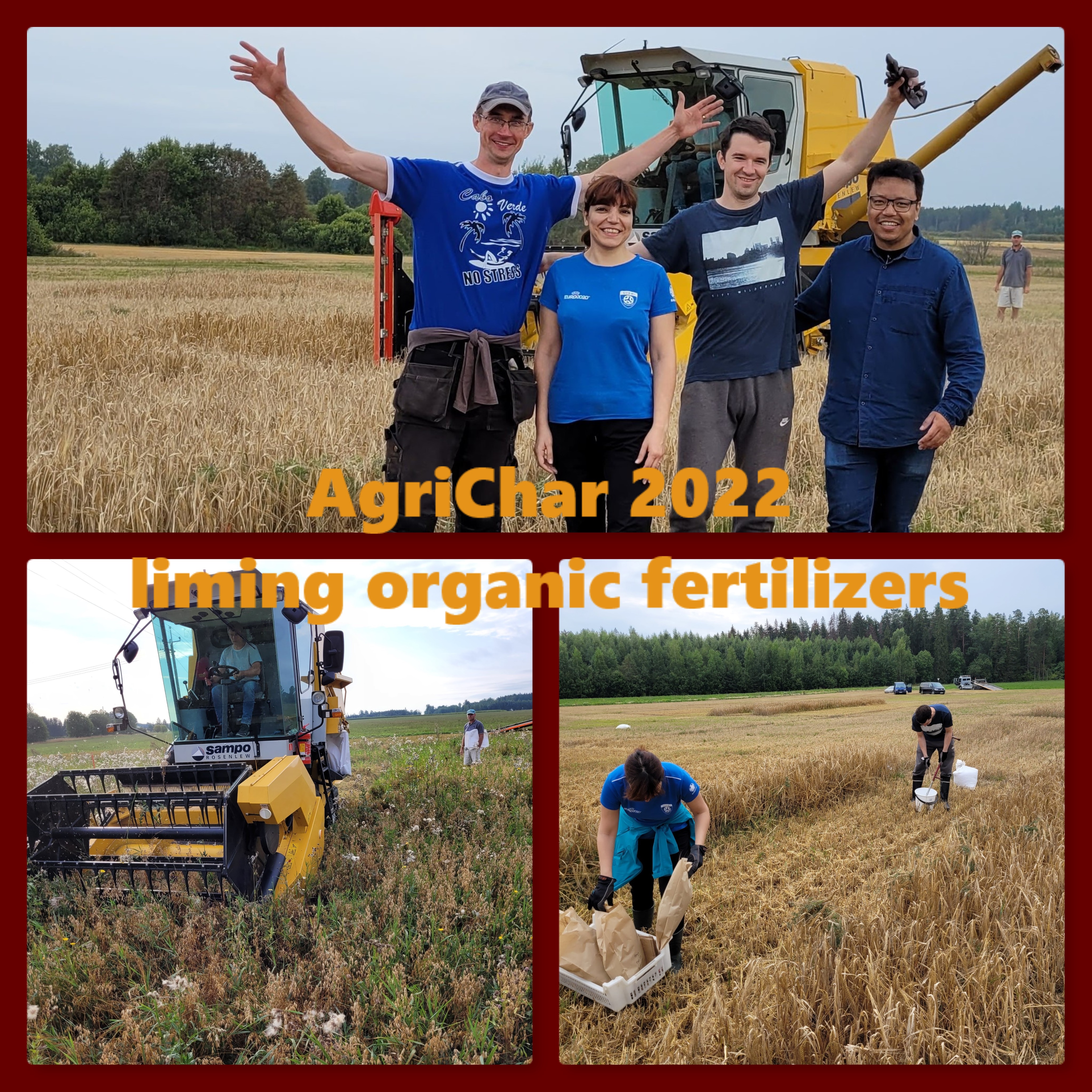
Our field experiments in Estonia harvested for 2022!

 Great success! Just before the rains we managed to sample and harvest our recycling fertilizer experiments focusing on granular fertilisers based on oil-shale ash and lime enriched with essential soil nutrients in Ahja and Aovere fields in Southern Estonia. The growing season was rather dry also in Estonia, but preliminary results are promising, both 2,5 t/ha and 5 t/ha application rates of fertilizer seemed to increase the yields. Next we will analyze the samples and finalize project reporting.

Dream Team of AgriChar group together with Estonian University of Life Sciences people managed well to sample and harvest the plots!

In this project we work in synergy with Estonian NGO Soil Innovation Cluster and Estonian University of Life Sciences, University of Tartu  and Ekosovellus and the aim of our work package is to test most suitable fertilizer recipes. Stay tuned for the results and check also other interesting results from the Cluster website https://soilprotection.earth!

Further, also our sediment recycling long-term field experiment and biochar drainage experiment were also sampled for plant and soil samples, as well as for leachate samples. And, of course, also the GHG emissions from the biochar and control treatments. This project is funded by Tiina and Antti Herlin Foundation, August Johannes and Aino Tiura Foundation as well as Emil Aaltonen Foundation. Thanks Mina, Subin and Jure for the excellent job!

Wednesday, 8 June 2022

Research seminars and collaboration with Dr. Dilfuza Egamberdieva

We have been happy to host Dr. Dilfuza Egamberdieva, research associate at the Leibniz Centre for Agricultural Landscape Research (ZALF), Germany, and Head of the Research Lab at the National University of Uzbekistan here in Helsinki. Dilfuza is a renowned environmental microbiologist and soil scientist. The main focus of her research is directed toward an understanding of the structural and functional organization of plant and soil microbial communities under various environmental ecosystems and their role in soil fertility and crop productivity. Since 2015 she is involved in biochar research, particularly as a beneficial soil amendment, and its impact on crop productivity.  She has joined our lab activities and supports research, particularly she contributes to our oil shale ash recycling work.

Dr. Dilfuza Egamberdieva has studied plant and soil microbial communities under various environmental ecosystems, including Aral sea watershed.

 
 In early June 2022 we had several seminars where Dr. Egamberdieva shared both her latest research and also advice for early career researchers on how to establish and keep alive successful research networks across the globe. As she has co-authored over 200 publications and belongs among the top 1 % of active reviewers according to Publons, her insights were really inspiring for us!  In the research seminar,  she shared her latest research on how biochars have been found to enhance legume-rhizobium symbiosis in challenging environments. Different biochars have different effects, and according to her experience, HTC hydrochar made of maize silage can be rather promising solution under many conditions. Hope to share soon our joint publications!